Our hearts go out to those who lost their lives last night in our hometown of Kalamazoo due to the senseless violence of what appears to be a random shooter. But as information has been released on the primary suspect’s identity, Jason Brian Dalton, we can only wonder if this tragedy could have been prevented by some quick action on the part of Uber, and we question whether that company could have taken extra steps to ensure the safety of its innocent passengers and bystanders. Based on initial reports, it is alleged that Mr. Dalton was an Uber driver who, in between alleged shootings, picked up passengers through the Uber app.
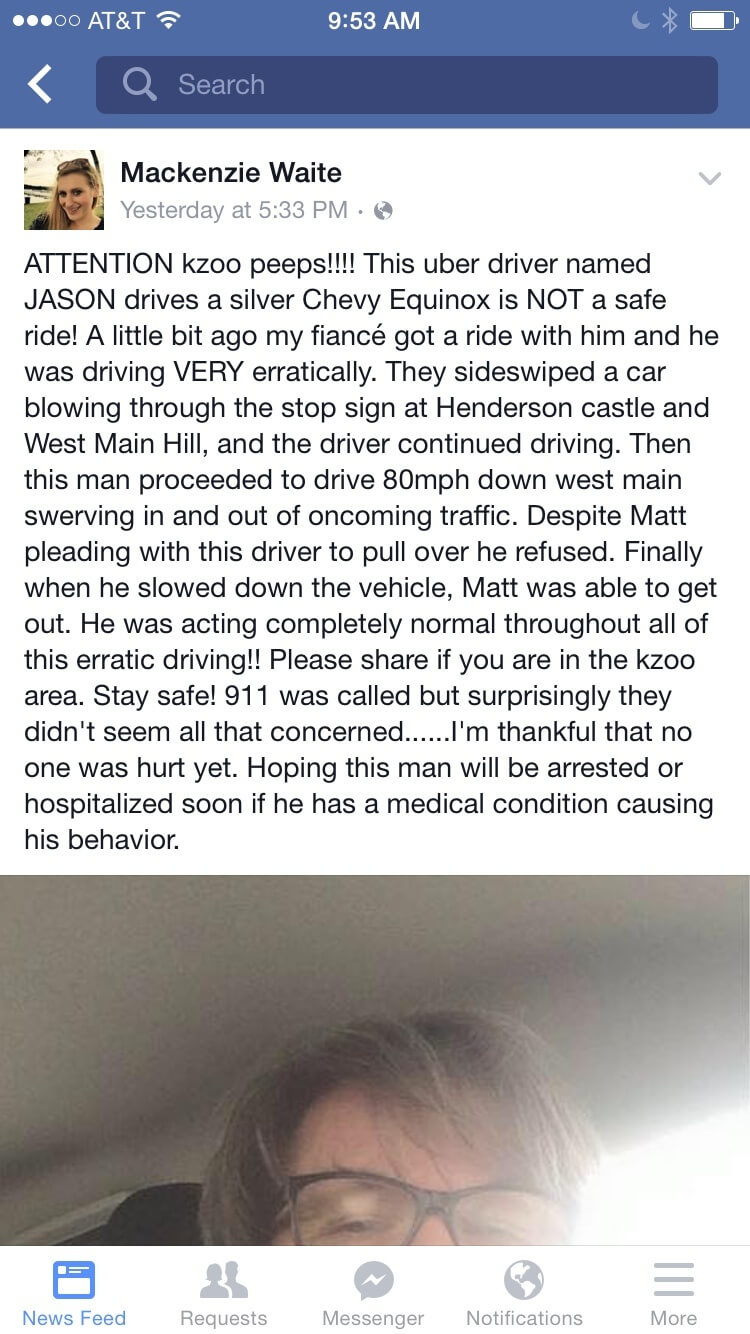
Approximately a half an hour before the first shooting was reported, the following post appeared on Facebook:
It is alleged that this post concerned Jason Brian Dalton, the alleged shooter. MLive reports that Ms. Waite called 911 and reported Mr. Dalton’s erratic behavior. And other third parties are reporting that Mr. Dalton may have dropped passengers off in between shootings.
Uber is certainly no stranger to passenger safety controversy, and we know from prior reporting that it has the ability to permanently deactivate the accounts of reckless drivers. But as the facts unfold, we can only wonder if Uber could have done more to detect this alleged driver’s erratic behavior, whether through software flags that identify a driver’s excessive rates of speed or through complaints from users such as Ms. Waite.
We hope that the police will act quickly to solve this crime and our thoughts are with the victims of this horrible tragedy.
The Legal Framework for Rideshare Driver Liability
The Kalamazoo shooting raised a fundamental question that courts and legislatures were still actively working through in 2016: when a rideshare driver commits a tort or a crime while logged into the platform, is the platform company liable? The answer turns on several overlapping legal theories — vicarious liability, negligent hiring, and negligent retention — and the facts of each case determine which theory has the strongest footing.
Vicarious liability under the doctrine of respondeat superior makes an employer liable for the torts of an employee committed within the scope of employment. Uber’s longstanding position — reinforced by its terms of service and its classification of drivers as independent contractors — is that drivers are not employees, and therefore Uber cannot be held vicariously liable for their conduct. But the independent contractor defense has been under sustained legal attack. The California Supreme Court’s decision in Dynamex Operations West, Inc. v. Superior Court, 4 Cal. 5th 903 (2018), adopted the “ABC test” for employment classification, making it substantially harder for gig companies to classify workers as contractors. California’s subsequent AB-5 codified that standard. Several other states have enacted similar measures, and the issue remains actively litigated in federal courts.
Negligent Hiring, Retention, and Supervision
Even if a driver is an independent contractor, the platform company may face liability under negligent hiring or negligent retention theories. These claims do not require an employment relationship — they require only that the defendant had a duty to exercise reasonable care in selecting and supervising the person who caused harm, and that a failure to exercise that care proximately caused the plaintiff’s injury.
For rideshare platforms, the duty analysis typically focuses on the foreseeability of harm: given what Uber knew or should have known about a driver’s history or in-app behavior, was it reasonably foreseeable that the driver posed a risk to passengers or the public? In the Kalamazoo case, the critical question was whether Ms. Waite’s report of erratic driving behavior — transmitted through or alongside the Uber app — was sufficient to put Uber on notice of a dangerous condition. If a passenger contacts Uber support mid-ride to report that a driver is driving erratically and Uber takes no immediate action, a court could find that Uber had actual notice of the risk and failed to respond reasonably.
Uber has demonstrated it can deactivate drivers in real time. The question is when it is legally obligated to do so. Courts have generally held that once a defendant has actual knowledge of a specific, credible danger, the failure to act on that knowledge can establish the breach element of a negligence claim.
Background Checks and the Standard of Care
The adequacy of rideshare background checks has been a focal point in litigation against Uber and Lyft. Unlike taxi companies and limousine services in many jurisdictions, rideshare platforms are not uniformly required to conduct fingerprint-based background checks. They typically use third-party services that conduct name-based checks against criminal databases, which are less comprehensive. Multiple lawsuits have alleged that drivers with criminal histories were permitted to use the platform because their records did not surface in name-based searches.
The legal standard is not perfection — it is reasonable care given the foreseeable risks of the particular business. A company that transports members of the public in private vehicles has a higher duty of care with respect to driver vetting than, say, a software company hiring a remote employee. Courts applying the reasonable care standard will ask what a reasonably prudent rideshare operator would do to vet its drivers, given the foreseeability that a driver who gains access to a passenger in a private vehicle could cause serious harm.
Legislative Responses: Rideshare Safety Laws
Since 2016, most states have enacted Transportation Network Company statutes that impose specific requirements on rideshare platforms. A majority of these statutes require background checks but leave the standard and method to the platform’s discretion. Some states — including New York City, under its Taxi and Limousine Commission rules — require fingerprint-based background checks for TNC drivers, which has generated ongoing litigation between TNC platforms and municipal regulators.
Michigan, where the Kalamazoo shooting occurred, enacted its Limousine, Taxicab, and Transportation Network Company Act, MCL § 257.2101 et seq., which requires TNCs to maintain a zero-tolerance policy for drug and alcohol use, conduct annual background checks, and provide insurance coverage at specified limits depending on whether the driver is logged in or carrying a passenger. The Kalamazoo tragedy directly accelerated legislative attention to the adequacy of these requirements.
Insurance Coverage During Rideshare Activity
The insurance dimension of rideshare incidents is complex. Uber and Lyft structure their coverage in three phases: (1) the driver is logged out of the app — personal auto insurance applies; (2) the driver is logged in but has not accepted a ride — contingent liability coverage of $50,000/$100,000/$25,000 applies; (3) a ride has been accepted or a passenger is in the vehicle — $1 million commercial liability coverage applies. Phase 2 coverage has been a source of significant litigation because many personal auto policies exclude coverage while the driver is using the vehicle for hire, creating a potential gap.
In the Kalamazoo incident, where the driver allegedly alternated between active rides and criminal activity, the applicable coverage phase at each moment of harm would be a central issue in any civil litigation. Victims injured while the driver was between rides would face a different coverage profile than victims injured during an active ride segment.
If you have been injured in an incident involving a rideshare driver, or if you are a business navigating transportation network company compliance requirements, Revision Legal’s attorneys can help. Contact us through the form on this page or call 855-473-8474.
Artificial intelligence has become part of nearly every business operation. Businesses now use AI tools to write marketing copy, generate product images, compose emails, draft social media posts, and produce video and audio content at a scale that was not possible a few years ago. The efficiency gains are real. But so are the legal […]
Receiving a cease and desist letter can feel alarming. One minute you are running your business as usual, and the next you are staring at a legal demand accusing you of trademark infringement, copyright violation, breach of contract, or some other wrong. The situation can escalate quickly if not handled properly. But receiving a cease […]
Learn what counts as deceptive pricing in e-commerce, including false discounts, hidden fees, drip pricing, and fake urgency. Revision Legal’s internet law attorneys help online retailers stay compliant with FTC rules.