

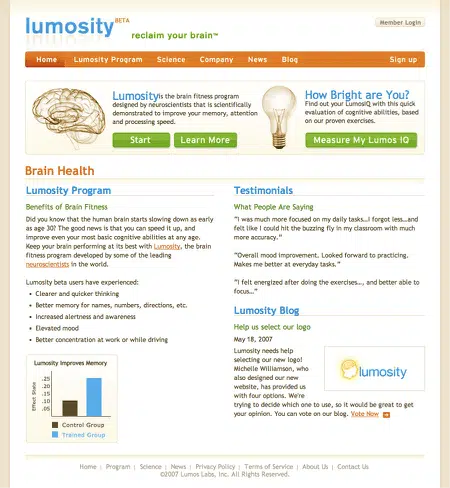
One of the major roles of the FTC is to prevent deception of consumers. They want the public to be able to make educated decisions regarding products they purchase and to know what they are looking at – for example, is the page they are viewing an ad or an informative page? If it is an ad, the FTC states that it needs to be identified as such.
In Lumosity’s case, both their advertising and the information pages of their website suggested that their training program could provide a multitude of health benefits to users in all aspects of their lives. Unfortunately for Lumosity, it had no scientific research to back these claims, so the claims were judged to be deceptive towards the public.
The FTC takes deception of consumers very seriously, and in this case found Lumosity’s claims could not be proven. Lumosity claimed the ‘brain training’ program would:
- Improve performance in everyday tasks, in school, at work, and in athletics;
- Delay age-related cognitive decline and protect against mild cognitive impairment, dementia, and Alzheimer’s disease; and
- Reduce cognitive impairment associated with various health conditions, and that scientific studies could back these findings.
A complaint was also lodged against Lumosity because they failed to disclose that some of their testimonials had been solicited through various contests the company had held.
In addition to the $2 million settlement, Lumosity will have to contact users and inform them of these charges. They will also need to provide users with the ability to cancel their auto-renewing memberships.
The FTC has not prevented Lumosity from continuing its programming or finding research that will support its current claims. Instead, the FTC order will require future advertising for the program to include scientifically backed facts only; or Lumosity can take a different route and opt to market its product in a completely different manner, just as long as the result of a new marketing plan does not suggest benefits which have no support.
For more information about the FTC, contact Revision Legal’s Corporate attorneys through the form on this page or by calling 855-473-8474.
FTC’s Authority Over Deceptive Advertising
The Federal Trade Commission Act, 15 U.S.C. § 45, prohibits “unfair or deceptive acts or practices in or affecting commerce.” The FTC’s enforcement authority covers advertising claims across all media—television, print, digital, and social—and extends to both objective claims (provable facts) and implied claims (messages that a reasonable consumer would take away from the advertising, even if not explicitly stated). An advertiser that makes a claim it cannot substantiate is engaging in deceptive advertising, even if the claim turns out to be true—the problem is the absence of a reasonable basis for the claim at the time it was made.
The FTC’s substantiation standard, articulated in its 1984 Policy Statement Regarding Advertising Substantiation, requires that objective advertising claims be supported by “competent and reliable evidence” before the claims are made. For health or safety claims—the category at issue in the Lumosity case—the FTC typically requires “competent and reliable scientific evidence,” which means well-designed, well-conducted studies applying generally accepted research methodologies.
What Lumosity Did Wrong
Lumosity’s advertising claimed that its “brain training” programs could improve performance in school, work, and athletics; delay age-related cognitive decline; and protect against mild cognitive impairment, dementia, and Alzheimer’s disease. These are objective, health-related claims subject to the FTC’s scientific substantiation standard. The FTC found that Lumosity lacked adequate scientific evidence to support these claims at the time it made them.
The FTC also found that Lumosity failed to disclose material facts in its testimonial advertising: specifically, that some consumer testimonials were solicited through contests in which Lumosity provided prizes to users who submitted the most compelling success stories. Under the FTC’s Endorsement Guides, 16 C.F.R. Part 255, material connections between an advertiser and an endorser must be disclosed. A contest that incentivizes favorable testimonials creates exactly the kind of material connection the Guides require to be disclosed.
The Settlement’s Ongoing Obligations
Beyond the $2 million civil penalty, Lumosity’s settlement with the FTC imposed ongoing behavioral obligations: the company must have competent and reliable scientific evidence for any future efficacy claims, must not misrepresent the existence or results of scientific studies, and must not make misleading claims about its subscriptions. The settlement also required Lumosity to notify subscribers about the charges and provide a mechanism to cancel auto-renewing subscriptions.
FTC consent orders run for 20 years and include monitoring and reporting requirements. Violations of an existing consent order expose the violating party to civil penalties of up to $50,120 per day per violation—a significantly more severe consequence than the original settlement. Companies operating under FTC consent orders should treat compliance as an ongoing legal obligation, not a one-time fix.
Lessons for Technology and Health App Companies
The Lumosity case illustrates several principles that any company making health, wellness, or performance claims in its advertising should internalize:
- Substantiate before you claim. The FTC’s deception analysis looks at the state of your evidence at the time the claim was made, not at evidence developed later.
- Health claims require scientific studies. Anecdotes, testimonials, and preliminary data do not satisfy the competent and reliable scientific evidence standard for health or efficacy claims.
- Disclose material connections in testimonials. If you pay, contest, or incentivize endorsers in any way, the connection must be disclosed—even if the endorser’s experience is genuine.
- Review your subscription terms. The FTC scrutinizes auto-renewal and negative option marketing practices; ensure your cancellation mechanisms are clear and functional.
If your company makes advertising claims about health, performance, or cognitive benefits, or if you have received an FTC inquiry or civil investigative demand, contact Revision Legal at 855-473-8474 or complete the contact form on this page. Our attorneys can review your advertising practices for FTC compliance before problems arise.
FTC’s Expanding Focus on Digital Health and App Claims
The Lumosity case was an early example of the FTC’s willingness to scrutinize health and cognitive claims made by app companies, but it was not the last. The FTC has since brought enforcement actions against companies making unsubstantiated claims about sleep improvement apps, stress reduction tools, and weight loss programs. The proliferation of wearable devices and health monitoring apps has expanded the FTC’s enforcement focus to include claims made by hardware manufacturers and platform companies, not just software developers.
Companies in the digital health space should be particularly careful about claims that a product will “improve,” “enhance,” “optimize,” or “protect” any health metric or cognitive function. Each of these claims implies a measurable effect that the FTC’s substantiation standard treats as a health or efficacy claim requiring competent and reliable scientific evidence. Vague claims about “wellness” or “supporting” cognitive health are less likely to trigger FTC scrutiny than specific, quantified claims—but the line between permissible puffery and actionable deception requires legal analysis specific to the company’s marketing materials. Contact Revision Legal at 855-473-8474 for FTC advertising compliance review.
The FTC actively monitors advertising compliance across all industries and media.