


Katherine Craig, a 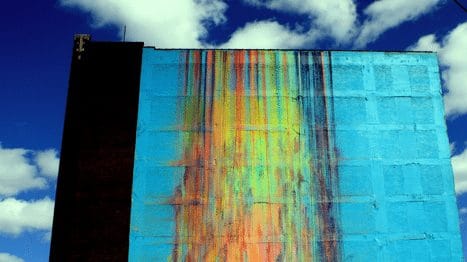 Detroit artist, is suing the Bloomfield-Hills based Princeton Enterprises because the developer wants to tear down a building in Detroit. While opposition to the destruction of buildings is not uncommon—particularly for older, historic buildings—Craig’s reason is quite different: she wants to preserve the 100-by-125-foot mural painted on the side of the building. Why? Because she painted it.
Click here for a Detroit News article on the story.
Craig painted the sprawling, colorful mural, aptly titled “The Illuminated Mural,” in 2009. It took her more than a year to complete, and she used 900 gallons of paint. In 2012, Craig registered her work for federal copyright protection.
In 2015, Princeton Enterprises bought the building with the hopes of tearing it down and redeveloping the area, or, keeping the building’s structure, but turning it into apartments, condos, or offices. Either way, Craig’s work would be materially destroyed. So Craig filed a federal lawsuit claiming that she owned the copyright to the mural, and therefore, she is the only person allowed to destroy it. In itself, this isn’t uncommon.
What makes Craig’s case so rare is the specific provision of the Copyright Act that she is using to make her argument. Craig is relying on the Visual Artists Rights Act (VARA) to make her claim. VARA was passed by the US Congress in 1990 in response to growing concerns that the United States did not respect the “moral rights” of authors in their work. While European countries have long seen copyright as both a protection of authors’ moral rights and a necessary way to incentivize artistic creation, the United States has historically focused only on the latter.
That changed to some extent in 1990. VARA is an extremely limited law. For instance, it only protects artists’ rights in paintings, drawings, prints, sculptures, and still photographic images. Further, there cannot be more than 200 copies of the work, and each copy must be signed and numbered by the author. See 17 U.S.C. § 106A.
Craig’s case is actually a pretty textbook application of VARA. Though the law is seldom used, when it is called upon, it is generally to protect large, public pieces of art like murals or statues. One of the more well-known VARA cases saw artist Kent Twitchell win over one million dollars when his 70-foot-tall mural in Los Angeles was painted over by the city.
But Craig does not seek money. Her complaint asks the court to grant her an injunction, which would bar Princeton Enterprises or any subsequent owner of the building from tearing it down. Whether or not Craig will be successful remains to be seen, as her case is still at the preliminary stages and there are still facts that need to be uncovered.
If you have any questions regarding VARA or the Copyright Act in general, or would like to speak to an expert copyright attorney about copyright registration or infringement, please give Revision Legal a call at 855-473-8474.
VARA’s Scope and Limitations
The Visual Artists Rights Act of 1990, codified at 17 U.S.C. § 106A, grants qualifying artists two moral rights: the right of attribution (to claim authorship and prevent attribution of works they did not create) and the right of integrity (to prevent intentional distortion, mutilation, or destruction of a work that would be prejudicial to the artist’s honor or reputation). For works of “recognized stature,” VARA goes further—prohibiting even intentional or grossly negligent destruction, under § 106A(a)(3)(B).
VARA applies only to works of visual art, which the statute defines narrowly: paintings, drawings, prints, sculptures, and still photographic images produced for exhibition purposes. Works made for hire, works created for commercial purposes, posters, maps, globes, and most applied art are explicitly excluded. The statute also imposes a 200-copy limitation—works existing in more than 200 copies do not qualify.
What “Recognized Stature” Means
The heightened protection against destruction—which Craig’s suit implicated—requires proof that the work has “recognized stature.” VARA does not define the term, leaving courts to develop their own tests. In Carter v. Helmsley-Spear, Inc., 71 F.3d 77 (2d Cir. 1995), the Second Circuit articulated a two-part test: (1) the visual art must have “stature,” meaning it is viewed as meritorious; and (2) that stature must be “recognized” by art experts, other members of the artistic community, or society in general. Expert testimony from art critics, curators, and gallery owners typically carries significant weight in this analysis.
A landmark VARA case involving public murals is Cohen v. G&M Realty L.P., 320 F. Supp. 3d 421 (E.D.N.Y. 2018)—commonly known as the 5Pointz case—in which a federal court awarded a group of aerosol artists $6.75 million after a building owner whitewashed their murals without providing the 90-day notice required by § 113(d) before destruction. The 5Pointz case significantly expanded the practical significance of VARA for public art, particularly in urban redevelopment contexts.
The § 113(d) Notice Requirement
When a work of visual art has been incorporated into a building such that removal would damage or destroy the work, § 113(d) provides two paths for building owners. If the artist executed a written instrument acknowledging that the work may be subject to destruction, modification, distortion, or mutilation by reason of removal, the building owner may proceed without restriction. If no such written instrument exists, the building owner must make a diligent, good-faith attempt to notify the artist, and must allow the artist 90 days to remove the work at their own expense.
Failure to follow these procedures exposes the building owner to the full range of VARA remedies, including injunctive relief preventing destruction and—as illustrated by 5Pointz—substantial statutory damages of up to $150,000 per work for willful violations.
Practical Advice for Artists and Property Owners
For artists whose murals or large-scale works are installed on property they do not own, the Craig case and 5Pointz illustrate both the power and the limits of VARA protection. Artists who register their works with the Copyright Office and document their recognized stature—through press coverage, museum recognition, and expert opinions—are best positioned to enforce VARA rights when threatened with destruction.
For property owners and developers who acquire buildings with existing murals or other large-scale art, VARA creates a real legal obligation that should be addressed in due diligence before purchase. The cost of complying with § 113(d)’s notice and removal procedures is far lower than the risk of a VARA damages award. Contact Revision Legal at 855-473-8474 or complete the contact form on this page if you are an artist facing destruction of your work or a property owner navigating VARA obligations.
Copyright vs. Property Rights: The Core Tension
The Craig case illustrates a fundamental tension in U.S. law between a property owner’s right to do what they wish with their property and an artist’s copyright interest in a work affixed to that property. VARA was Congress’s attempt to balance these interests by creating a limited window—the 90-day notice period under § 113(d)—during which the artist can reclaim their work before it is destroyed. Property owners who act within this framework are generally protected from VARA liability. Those who do not—like the 5Pointz building owner who whitewashed murals overnight without notice—expose themselves to significant damages. For questions about VARA, mural commissions, or public art disputes, contact Revision Legal at 855-473-8474.


