




Editor’s note (October 2026): In 2021 the FTC adopted the Made in USA Labeling Rule (16 C.F.R. Part 323), which allows the FTC to seek civil penalties for unqualified ‘Made in USA’ claims on labels that do not meet its standard. Contact Revision Legal for current advice.
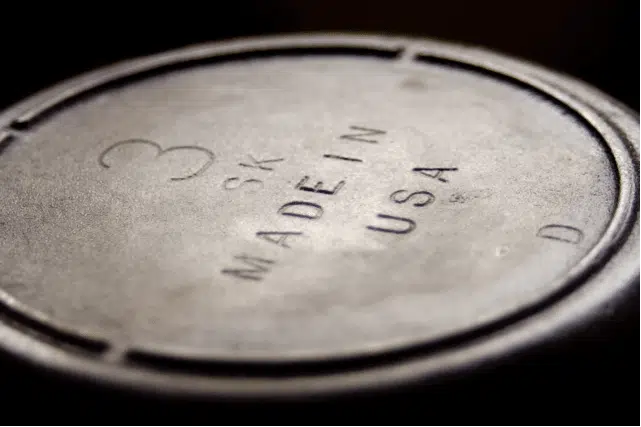
Most recently, on February 1, the FTC brought a claim in Ohio against Chemence, Inc. over their fast-acting glue products, including Kwik Frame, Kwik Fix, and Krylex. Allegedly, fifty-five percent or more of the main chemicals used in the glues are not US-made. There are additional allegations that Chemence has been helping others to deceive consumers by giving private sellers and other retailers their marketing material and convincing these other retailers to sell Chemence’s products with the “Made in USA” sticker intact.
Given how new the claim is, there currently isn’t much known beyond the FTC’s allegations. In their claim, the FTC is asking the court to grant a permanent prohibition against Chemence to prevent them from making any future claims that violate the FTC Act, in addition to a request for monetary damages.
For additional information on the FTC “Made in USA” you can view this post on a Michigan company under investigation or review the policy details as provided by the FTC.
To seek legal advice about the FTC regulations around “Made in USA” and whether or not you should be concerned, contact Revision Legal’s Corporate attorneys through the form on this page or call 855-473-8474.
Image credit: Flickr user Nic McPhee
The FTC’s “Made in USA” Standard
The Federal Trade Commission’s “Made in USA” standard requires that a product claimed to be “Made in USA” be “all or virtually all” made in the United States. Under the FTC’s 1997 Enforcement Policy Statement on U.S. Origin Claims — still operative today and now supplemented by the FTC’s 2021 “Made in USA” Labeling Rule — “all or virtually all” means that all significant parts, processing, and labor that go into the product must be of U.S. origin. Products that contain foreign components must not bear unqualified “Made in USA” claims; any qualification must be clear, prominent, and accurate.
The 2021 rule, codified at 16 C.F.R. Part 323, for the first time gave the FTC explicit civil penalty authority for unqualified “Made in USA” misrepresentations. Prior to the rule, the FTC could only seek civil penalties through the consent order process — a company that had previously been ordered to stop making deceptive origin claims and then violated the order faced penalties, but a first-time violator without a prior order generally faced only injunctive relief. The 2021 rule closes that gap: civil penalties of up to $43,792 per violation per day are now available against any company that violates the standard, without the need for a prior consent order.
What the Chemence Case Illustrates
The FTC’s action against Chemence illustrates several recurring patterns in “Made in USA” enforcement. First, the FTC targets the manufacturer, the distributor, and the retailers separately when the deceptive labeling travels through the supply chain with the product. Chemence was alleged not only to have applied the “Made in USA” label to products whose primary chemical inputs were foreign-sourced, but also to have provided marketing materials to downstream retailers that perpetuated the deception. Under the FTC Act, supplying the instruments of deception — the labels and marketing materials — to a third party can constitute an unfair or deceptive practice regardless of whether the supplier is the entity making the claim to end consumers.
Second, the FTC looks at the cost of foreign content relative to the total manufacturing cost. If more than a minor or insignificant proportion of the total manufacturing cost is attributable to foreign parts or processing, the “all or virtually all” standard is not met. For Chemence, the allegation that 55% or more of the main chemical inputs were foreign-sourced put the company well outside any reasonable reading of the standard. Cases involving borderline proportions — say, 10–15% foreign content — require closer factual analysis and often turn on whether the foreign components are significant to the product’s function or cost.
Qualified “Made in USA” Claims
A manufacturer whose product does not meet the “all or virtually all” standard may still make a qualified origin claim, provided the qualification accurately discloses the extent of U.S. content. Permissible qualified claims include: “Made in USA of U.S. and imported parts,” “Assembled in USA from imported components,” or “60% U.S. content.” These claims are lawful provided they are accurate and the qualifications are presented clearly and conspicuously — not buried in fine print or presented in smaller type than the “Made in USA” portion of the claim.
Qualified claims require the same factual basis as unqualified claims. A claim that a product is “Assembled in USA” requires that the assembly — the process of putting components together — actually occurs in the United States and that the claim is not so qualified as to be misleading. A product whose foreign components are merely packaged in the United States is not “assembled” in the United States in any sense the FTC would accept.
State “Made in USA” Laws
California has its own “Made in USA” law, Cal. Bus. & Prof. Code § 17533.7, which imposes a stricter standard than federal law. California prohibits any “Made in USA” claim on a product sold in California unless the product and its component parts were entirely made, manufactured, or produced in the United States. This is a zero-tolerance standard: any foreign-sourced component, however minor, disqualifies the product from bearing an unqualified “Made in USA” claim under California law. California’s statute allows private plaintiffs to bring suit under the Unfair Competition Law (UCL), Cal. Bus. & Prof. Code § 17200, and class actions have been filed against multiple manufacturers under this provision.
Companies selling nationally must therefore decide whether to design their labeling to the California standard — which effectively means no “Made in USA” claim unless every component is U.S.-sourced — or to maintain separate labeling for California versus other states, which creates its own compliance burden. Given the volume of class action litigation under the California UCL, most companies opt for California-compliant labeling nationally.
Compliance Audit and Risk Management
If your company makes “Made in USA” claims on any product or in any marketing material, the first step is a supply chain audit: map every component, raw material, and processing step, identify where each originates, and calculate the percentage of total manufacturing cost attributable to foreign-sourced inputs. If the calculation shows less than “all or virtually all” domestic content, the claim needs to be removed or qualified before the next production run.
Document the audit. If the FTC or a state attorney general investigates your labeling practices, you will need to demonstrate that you had a reasonable factual basis for the claim at the time it was made. A contemporaneous supply chain audit is your best evidence. Companies that cannot produce such documentation are in a significantly weaker position when the FTC requests substantiation.
For advice on “Made in USA” compliance, FTC labeling regulations, or responding to an FTC inquiry, contact Revision Legal’s corporate and FTC compliance attorneys through the form on this page or call 855-473-8474.


