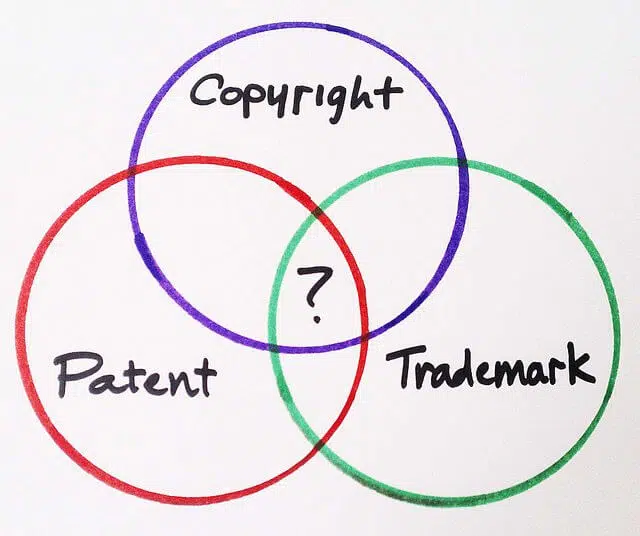
The world of intellectual property law primarily focuses on protecting assets. And the law provides different forms of protection depending on the asset. In general, these protections are found in copyrights, trademarks, and patents. These three types of protection apply to very specific assets, but it can be easy to confuse the three. To help clear up this confusion, here is a basic introduction to copyrights, trademarks, and patents.
Copyrights
Copyright is a form of protection to authors of “original works authorship” of certain kinds of work. Specifically, copyright protections apply to literary, dramatic, musical, pictorial, sculptural, and graphic works, among others.
Copyright protections give the copyright owner the exclusive ability to reproduce, distribute, perform, publicly display, and make derivative works of the owner’s original content.
Those rights begin at the moment the work is created in a fixed, tangible form. For example, the moment you take a picture, and it’s in a tangible form, whether on film, on paper, or digitally stored in your cell phone, you have copyright rights in that photograph.
Copyrights can be registered with the United States Copyright Office. Even though copyright rights exist prior to registering, registering does provide a number of benefits.
Trademarks
While copyrights protect original works of authorship, trademarks are designed to identify a source of goods or service. A trademark, or service mark, includes any word, name, symbol, or any combination of them, that’s used or meant to be used to identify the sources of the goods/services of one company from those of other companies. Basically, a trademark is a logo or name that sets something for sale apart from its competitors and makes it recognizable on the market.
Trademarks are designed to protect the public by limiting confusion in the marketplace. Successful businesses build brands and obtain goodwill by meeting their customers’ expectations. And those customers should be able to seek out the products or services of that business without confusion. Trademark law prevents a competing business from attempting to capitalize on that goodwill by using a confusingly similar mark.
Patents
Patents protect inventions — utilitarian processes, machines, manufactured articles, and compositions of matter. A utility patent grants the inventor the exclusive right to make, use, sell, and import the invention for a period of twenty years from the application filing date, in exchange for public disclosure of how the invention works. Design patents, which protect the ornamental appearance of a functional item, have a fifteen-year term. Plant patents protect new varieties of asexually reproduced plants.
Unlike copyright, which arises automatically upon creation of a work, patent rights only exist if a patent is granted by the USPTO. The application process is complex and expensive, requiring a detailed written description of the invention that enables a person skilled in the relevant field to make and use it, along with claims that define the legal scope of the protection sought.
Key Differences: Copyright vs. Trademark vs. Patent
Understanding which form of protection applies to a particular asset is one of the first and most important questions in any intellectual property matter. The following breakdown covers the most significant distinctions:
What Each Protects
Copyright protects original works of authorship — books, music, software code, photographs, films, architectural works, and other creative expression fixed in a tangible medium. It does not protect ideas, facts, systems, or methods of operation — only the expression of those things.
Trademark protects brand identifiers — names, logos, slogans, product packaging, and other source identifiers that distinguish one seller’s goods or services from those of others. It does not protect the underlying product or the creative content of advertising.
Patent protects inventions — new, useful, and non-obvious processes, machines, compositions, and improvements. It does not protect abstract ideas, laws of nature, or natural phenomena.
Duration of Protection
Copyright lasts for the life of the author plus 70 years for works created after January 1, 1978 (17 U.S.C. § 302). Works for hire have a term of 95 years from publication or 120 years from creation, whichever is shorter.
Trademark protection can last indefinitely as long as the mark is in use in commerce and renewals are filed with the USPTO. Registrations must be maintained with use and renewal filings every ten years, with an additional use declaration due between the fifth and sixth year.
Patent protection lasts 20 years from the filing date of the patent application (utility patents) or 15 years from the date of grant (design patents). There are no renewals — once expired, the invention enters the public domain.
Registration Requirements
Copyright protection arises automatically upon creation. Registration with the U.S. Copyright Office is not required to have rights, but it is required to file an infringement lawsuit in federal court and to be eligible for statutory damages (up to $150,000 per willful infringement) and attorney’s fees.
Trademark rights arise from use in commerce. Federal registration with the USPTO provides significant advantages — nationwide priority, the right to use the ® symbol, and access to federal court jurisdiction — but is not required to have enforceable rights.
Patent rights only exist if a patent is granted. There are no common law patent rights. You must file an application, survive examination, and receive a grant from the USPTO.
Can the Same Asset Get Multiple Types of Protection?
Yes — and this is one of the most powerful aspects of a well-structured IP strategy. Consider a software product. The source code is protected by copyright from the moment it is written. The product name and logo are protectable as trademarks. The underlying algorithm or user interface interaction may be patentable. Trade secrets law (the Defend Trade Secrets Act, 18 U.S.C. § 1836) protects confidential information that has economic value from its secrecy, such as proprietary processes, formulas, and business methods. A comprehensive IP strategy identifies all protectable assets and applies the appropriate form of protection to each.
Mobile game developers are a good example of this overlap: the game’s code and artwork are copyrightable, the game’s name and characters are protectable as trademarks, and certain novel game mechanics may qualify for patent protection. Each form of protection addresses a different competitive threat.
Revision Legal handles trademark registration and litigation, copyright registration and enforcement, and intellectual property counseling for businesses of all sizes. If you have questions about protecting your brand, your creative work, or your invention, contact us at 855-473-8474 or complete the contact form on this page.
Receiving a cease and desist letter can feel alarming. One minute you are running your business as usual, and the next you are staring at a legal demand accusing you of trademark infringement, copyright violation, breach of contract, or some other wrong. The situation can escalate quickly if not handled properly. But receiving a cease […]
The EEOC confirmed that employers reopening businesses may conduct COVID-19 health screenings without violating disability discrimination laws. Here’s what’s allowed.
Competitors scraping your e-commerce prices and SKUs is a growing legal problem. Revision Legal’s e-commerce attorneys explain your legal options for stopping scrapers and protecting your product data.